
"S-Curve Analysis" by Futures Platform
Exploring foresight 🔭

Here are all my highlights from the article recently published by Tuomo Kuosa and Gökce Sandal.
I usually highlight interesting phrasings or fresh insights that i discover in specific materials like this one.
Intro
“S-curve analysis can help pinpoint emerging change signals before they evolve into prominent trends, giving organisations a strategic view to enter the market when the timing is ripe for maximum potential.
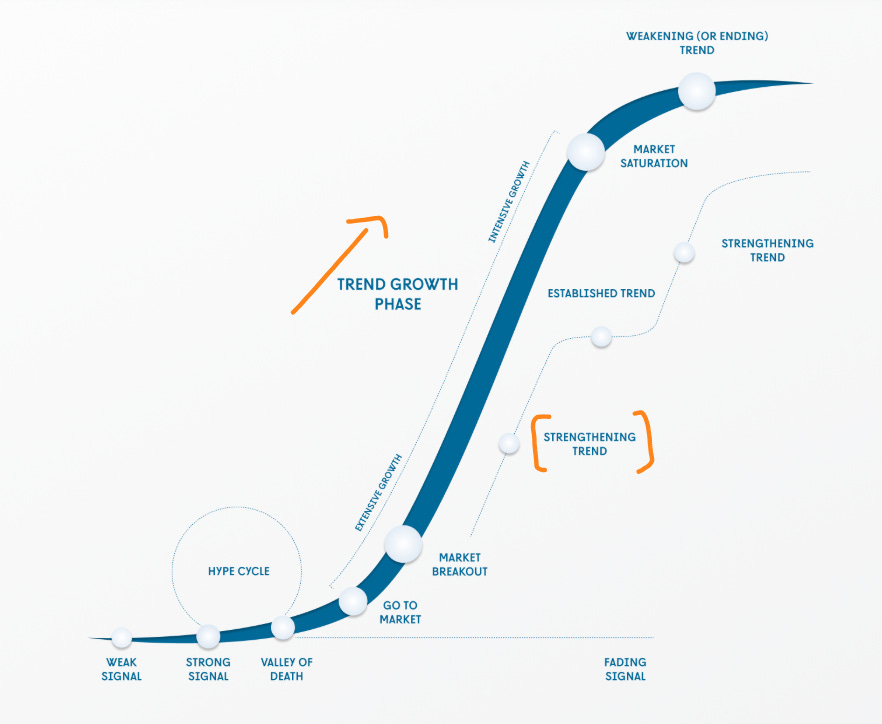
discern whether an established trend still has room for growth or if it's poised to lose momentum
Growing trends, having journeyed a significant portion of the curve, can be tracked using historical data such as investment and market growth rates, along with indicators like Google Trends, to pinpoint where it stands on its S-curve trajectory.
In contrast, emerging change signals lack such historical data points due to their nascent nature. Positioned at the outset of the S-curve, these signals either ascend along its trajectory or plateau if they fail to reach the necessary inflection point for widespread adoption.
In theory, interconnected trends and phenomena progress along the S-curve in unison as they share the same underlying change drivers and face similar bottlenecks.
For instance, the rise of electric vehicles and renewable energy are both driven by the shared underlying change driver, which is the need to reduce carbon emissions.
Both also face comparable bottlenecks, such as infrastructure development and public acceptance.
Hence, when a new change signal aligns with an existing cluster of trends, it offers insight into its probable behaviour and trend potential.
Often, change signals originating solely from one domain of the PESTLE framework lack the robust foundation needed to evolve into trends.
A technology might be promising, but there may not be a social need for it, or there might be major legislative hurdles on the way. But when a diverse set of change drivers align without major barriers, there is a strong likelihood that the phenomenon will gain momentum and evolve into a trend within a foreseeable timeframe.
Weak signals are emerging change signals in their infancy, which are known only among subject matter experts and pioneers
A weak signal transforms into a strong signal when it garners attention from journalists and the public.
Strong signals often entail technologies or emerging concepts with significant innovative potential, but they lack practical applications as they are still in the conceptual stage.
When strong signals gain a lot of interest before the concept materialises, hype cycles often form and inflate expectations.
Hype cycles can form due to various factors, such as excessive media coverage, the novelty of the phenomenon, or a corporation generating hype around its new innovation with a substantial marketing budget.
When a hyped strong signal fails to materialise or meet inflated expectations, the hype cycle eventually concludes, and the overinflated market bubble bursts.
At this juncture, interest diminishes, and the change signal descends into what is often termed the valley of death.
Following this period, the change signal may take two paths.
It may disappear entirely if it was merely a passing fad lacking the underlying driving forces to grow into a trend.
Conversely, if the signal possessed trend potential but was hindered by unripe market conditions, it can resurface when the conditions align favorably.
Once a change signal materializes into a prototype or proof-of-concept product or service, and early adopters and opinion leaders begin using it and influencing the broader audience, this juncture typically marks the opportune moment to enter the market.
The market experiences a breakthrough when the early majority adopts the trend, sparking rapid and extensive growth.
During this initial growth phase, demand outstrips supply, providing opportunities for all suppliers to thrive.
Following the market breakthrough, the change signal becomes a strengthening trend, steadily gaining momentum and increasing influence.
Subsequently, as the initial phase of extensive growth subsides, market competition intensifies.
This compels suppliers to refine their processes, expand operations, differentiate their offerings, or consider mergers to maintain success in the evolving landscape.
Sometimes, the strengthening phase of a trend may pause before it resumes its upward trajectory along the S-curve.
During this established phase, trends maintain sustained relevance and growth potential, although they are not actively growing at the moment.
While the established phase shares similarities with the valley of death phase, the valley of death occurs before a trend materializes, whereas the temporary established phase occurs within an existing trend.
At a certain point, the trend begins to lose momentum as new trends and change signals emerge to replace it, or it reaches full utilisation, leaving no room for further growth.
In both cases, the trend enters its market saturation phase and is deemed a weakening trend, meaning that it no longer has any real relevance.”
Through the Fog of Foresight is a series of notes and reflections while exploring Futures and Foresight 🔭
Written by Bülent Duagi, strategy adviser for CEOs in Tech.